24-13-00204
Russian Science Foundation
Period: 2024–2026
RSCF №24-13-00204
(2024—2026)
Annotation
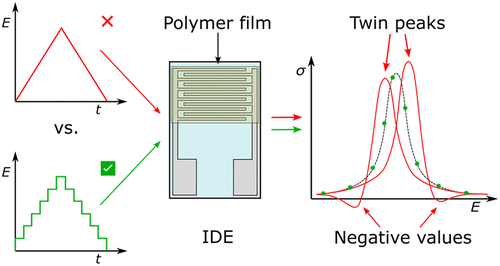
Stimuli-responsive materials that change their properties under the influence of an external stimulus are the basis of many sensing and actuating devices. In the field of lithium-ion batteries (LIA), materials with variable conductivity are of particular importance to prevent the development of processes leading to overheating and explosion of the battery in case of overcharge or short circuit. A promising approach to LIA protection using conjugated conductive polymers that change to a non-conductive state when the dangerous electrode potential value is reached has been recently proposed by the authors of the project. The key property determining the protective properties of the considered materials is the bell-shaped dependence of their conductivity on the applied potential. For the observed effect the authors propose to use the term "potentioresistivity" by analogy with "thermoresistivity". At the moment the application of potentioresistive protection is limited by the range of conductivity of known conducting polymers. However, varying the conduction window of potentioresistive materials is fundamentally possible, and can be used to create materials whose conduction window corresponds to different LIA configurations.
As a key hypothesis of the project, the authors assume that the creation of potentioresistive materials with predetermined parameters of the conduction window can be realized on the basis of composites of conducting polymers with redox additives, where the composition of the composite will determine the parameters of the conduction window. The verification of this hypothesis, identification of the patterns postulated in it and their practical implementation for the protection of lithium-ion batteries constitute the main goal of the project.
The main objectives of the project include three blocks:
- Analyzing the influence of redox additives of different nature (components capable of reversible redox transitions) on the electrochemical properties of thin films of conductive polymer matrix.
- Analyzing the effect of thickness and morphology of composite polymeric materials on their electrical conductivity.
- Testing the protective properties of new materials as part of prototype lithium-ion batteries.
Successful implementation of the project will make it possible to synthesize materials with a controlled range of potentials and amplitude of change in electrical conductivity, which is relevant for their use as protective layers in battery systems and other devices. The fundamental significance of the project lies in the creation of a theoretical basis for the molecular design of potentioresistive materials. As far as the authors of the project know, the proposed concept of creating potentioresistive materials based on conducting polymers doped with redox additives has not been described in the literature.
Expected results
The research project aims to study and develop materials based on conductive polymers modified with redox additives, with a focus on their electrical conductivity. The project is spread over three years, each with specific objectives.
Year One
The objectives of the first year of the project are related to developing measurement techniques, validating them against available materials, and testing new materials as they become available. Expected results include:
- Establishing the influence of cross-border charge transfer, morphology and thickness of the conjugated polymer film on the potential dependence of its electrical conductivity.
- Identification of regularities describing the influence of the concentration of redox additives on the electrical conductivity of blends and interpolymer complexes.
- Improvement and justification of the methodology for quantitative determination of specific electrical conductivity of the studied polymers.
Year Two
Second year objectives include synthesis of redox additives for polyelectrolyte composites, grafting of redox groups onto a conducting matrix, and exploratory studies in copolymerization. The synthesis of monomers with grafted redox centers and block copolymers is carried out. Additionally, limits on the conductivity values of films used to prevent the ignition of lithium-ion batteries are determined.
Year Three
The focus shifts to the synthesis of more complex systems to confirm assumptions made early in the project. Synthesis of systems with charged and bulk substituents that do not exhibit redox activity is being performed.
As a result of the project as a whole it is envisioned to:
- Develop approaches to specifically modify the conductivity range of materials based on conjugated polymers.
- To obtain new materials with the range of conductivity corresponding to the operating potentials of high-voltage cathodes of lithium-ion batteries.
- To test the protective properties of the developed materials.
Scientific significance of the project results
The project contributes to the understanding of the relationship between composition, mechanism and rate of charge transfer, and electrical conductivity in conductive polymers modified with redox additives. The expected results address fundamental questions of polymer science in electrochemistry, they expand knowledge in this field and open a new direction for the development of redox-conducting polymers with variable electrical conductivity.
Social significance of the project results
The materials developed can find application in various economic and social contexts:
- Improved energy storage. The resulting materials can improve the performance and safety of lithium-ion batteries, meeting the growing demand for efficient energy storage solutions.
- Electronics and technology. Variable conductivity materials can help create new electronic devices, actuators, transistors, sensors, and other technologies.
- Environmental Impact. Improved battery performance can help develop more sustainable and environmentally friendly energy storage solutions.
Publications 4
|
A numerical investigation into adaptive resistance components for protecting lithium-ion batteries from short circuits
|
2026 |
|
Limitations of Cyclic Voltammetry on Interdigitated Electrodes for Evaluating Polymer Conductivity
|
2026 |
|
Potentioresistive polymer layer to protect lithium-ion battery from internal short circuit driven thermal runaway
|
2026 |
|
Direct electrochemical co-polymerization of EDOT and hydroquinone
|
2025 |